MCP vs. Skills:
The Architecture of Agency
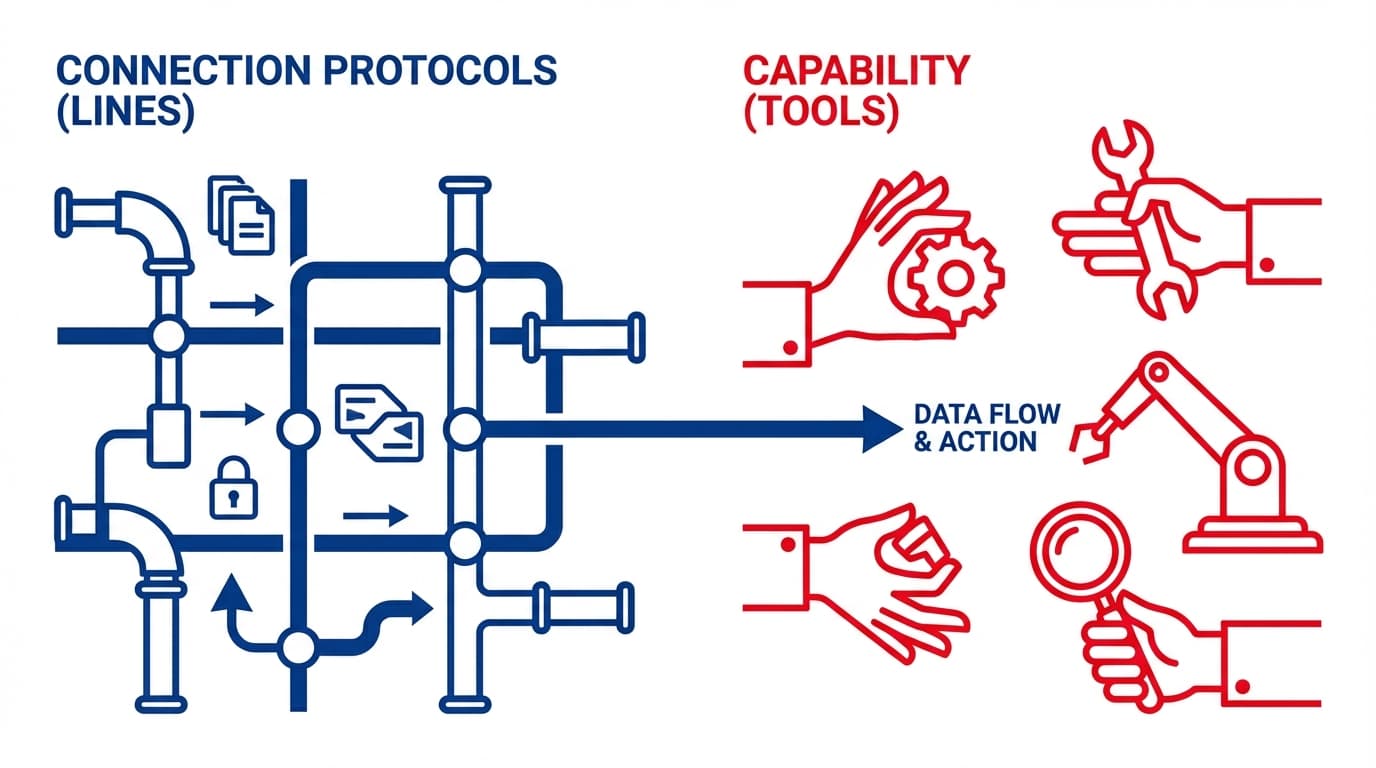
In the rapidly evolving landscape of AI agents, two terms often cause confusion: Model Context Protocol (MCP) and Skills. While both extend an AI's capabilities, they solve fundamentally different problems in the agentic stack.
01The Core Distinction
MCP (The Connection)
- ✓ Standardized protocol (like USB-C)
- ✓ Connects to Data (Files, DBs)
- ✓ Server/Client architecture
- ✓ "Read/Write" focus
Skills (The Know-How)
- ✓ Modular instruction sets
- ✓ Provides Process (How-to)
- ✓ Markdown/Script based
- ✓ "Execute/Perform" focus
Think of an AI agent as a new employee. MCP is giving them access to the company Google Drive, Slack, and GitHub repository. It's the permission and pipe to access information.
Skills are the training manuals and standard operating procedures (SOPs). Even if the employee has access to GitHub (via MCP), they might not know how your team formats pull requests. The "Pull Request Skill" teaches them that specific procedure.
02When to Use Which?
| Scenario | Use MCP | Use Skills |
|---|---|---|
| "Read my emails" | YES (Gmail MCP) | No |
| "Write emails in my tone" | No | YES (Copywriting Skill) |
| "Query the SQL database" | YES (Postgres MCP) | No |
| "Generate a monthly report" | Yes (Fetch data) | Yes (Format report) |
03The "Better Together" Workflow
The most powerful agents combine both. In a sophisticated workflow:
- MCP connects the agent to live data sources (e.g.,
stripe-mcp). - Skills provide the domain expertise to analyze that data (e.g.,
financial-analysis-skill). - The agent uses the Skill to generate code that queries the MCP server.
"MCP connects Claude to data; Skills teach Claude what to do with that data."
04Conclusion
As you build your agentic toolkit, stop looking for "one tool to rule them all." Use MCP for connectivity. Use Skills for capability. Together, they form the nervous system and the muscle memory of your digital workforce.